

Meta Title: Retatrutide Results Timeline UK – What to Expect | BuyPeptids
Meta Description: Explore a research-based timeline of Retatrutide effects in the UK. Learn how responses may develop over weeks in early studies and discussions.
Introduction
Interest in Retatrutide in the UK is largely driven by one question:
“How long does it take to see results?”
While it is still an emerging compound, early research discussions and clinical trial observations provide a general timeline of how responses may develop over time.
Important Disclaimer
This article is for informational and educational purposes only.
It is not medical advice and does not provide usage instructions.
Week 1–2: Initial Adaptation Phase
During the early phase, most focus is on tolerance and adjustment.
Commonly discussed observations:
- Appetite changes may begin early
- Mild digestive adjustment can occur
- Energy levels may fluctuate
This stage is primarily about the body adapting to new signalling pathways.
Week 3–4: Early Response Phase
As exposure continues:
- Appetite suppression may become more noticeable
- Eating patterns may begin to shift
- Body begins adjusting to metabolic signalling changes
At this stage, effects are still stabilising rather than fully developed.
Week 5–8: Progressive Response Phase
In many research discussions, this is when changes become more consistent:
- More stable appetite regulation
- Gradual changes in eating habits
- Early metabolic shifts become more apparent
This phase is often described as a transition period.
Week 8–12: Stabilisation Phase
Later early-stage observations suggest:
- More consistent appetite control
- Reduced fluctuation in daily response
- Improved overall tolerance for many users
This is where patterns typically become clearer.
Beyond 12 Weeks: Extended Observation Phase
Longer-term research focus includes:
- Sustained metabolic response
- Ongoing adjustment to multi-pathway signalling
- Evaluation of consistency over time
How Retatrutide Differs Mechanistically
Unlike single-pathway compounds such as:
- Semaglutide
or dual-pathway options like:
- Tirzepatide
Retatrutide targets:
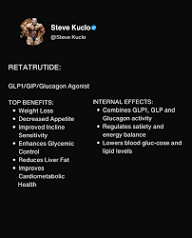
- GLP-1
- GIP
- Glucagon receptors
This broader mechanism may influence the gradual and layered response timeline.
Factors That Affect Individual Timelines
1. Metabolic Differences
Everyone responds at different speeds.
2. Adjustment Rate
Some individuals stabilise quickly, others require longer adaptation periods.
3. Lifestyle Consistency
- Diet patterns
- Activity levels
- Routine stability
4. Prior Experience
Previous exposure to similar compounds may influence how quickly changes are noticed.
Common Misinterpretations
“No early changes means it’s not working”
Early weeks are often adaptation-focused rather than outcome-focused.
“Faster results mean better results”
Speed does not always reflect quality or sustainability of response.
“Everyone follows the same timeline”
Real-world responses vary significantly.
UK Context Overview
In the UK, Retatrutide discussions are still emerging, with most interest focused on:
- How it compares to existing GLP-1 therapies
- Expected progression timelines
- Long-term metabolic potential
Key Takeaways
- Early weeks focus on adaptation
- Noticeable changes often build gradually
- Stabilisation typically occurs after several weeks
- Retatrutide works across multiple metabolic pathways
- Individual response timelines vary widely
Final Thoughts
The Retatrutide timeline is best understood as a gradual, multi-stage process rather than an immediate shift.
Because it interacts with multiple pathways, changes tend to develop progressively over time rather than suddenly.
Leave A Comment